It was like 3 weeks since I last posted something here. It's not that I have run out of things to write, but it's because I am too busy with my things on hand. I have recently made a very big decision on my life. I quit my job!! This could be for the better or worse. Anyway, the decision has been made, and there is no turning back now, for me.. I really wanted to share this feeling with someone, but dunno who to talk to.. so well, what's a blog for if it's not something for you to release your feelings within ?
Suddenly realised that I haven't talk much about myself here. To cut the story short, I am a degree holder in Accounting and Finance. Most people thought that I would have gone into a big accounting firm or bank or stock broking firm or something like that when I graduated, back in year 2001. But I didn't. I thought those are boring jobs, so I opted for a job as a sales executive in a chemical plant. Sounds more exciting and interesting as the incomes were based on commissions, so the potential of making it big time is higher, and there were more things to learn, I so thought back then, when I was much more naive than I am now. Anyway, as the years go by, I was transferred from the sales department to project management, to build a new plant and operation head to start up a new plant and so on. Basically, I have involved from A to Z of starting a business. And without noticed, I am already getting a pay which is few times higher compared to when I first joined the company, and I will have an easy and confortable life if I stick to what I am doing, at least for another few more years. I should be happy by now. But I am not! I felt like I have to move on and away from this comfort zone in order to grow. And hence, I have tendered my resignation and I will officially unemployed from the 31st August 2007, coincided with the Independence Day of Malaysia.
Well, life's gonna be different when I am all alone out there, I think. And I also have to figure out how to make a living going forward. But I have a rough idea in mind and an ambition which I so wish to accomplish in my life. I wanted to be one great investor like Warren Buffett. So, I might want to start off my dream by setting up an investment vehicle like what Mr Buffett did back then with his Buffett Partnership. I wanted to make those people around me, who have trust in me, millionaires, like what Mr Buffett had done to his investors.. This is my target, my dream and I am going to make it happen!!
Wednesday, July 25, 2007

Wednesday, July 04, 2007
How to invest in the right business
I came across a good article in the Star today, "How to invest in the right business" by Ooi Kok Hwa. I have extracted some good points, with my comments:
Warren Buffett, in his address as chairman to Berkshire Hathaway shareholders, said he uses four main criteria to select the right business: (1) a business that he understands, (2) one with favourable long-term prospects, (3) one that is operated by honest and competent people; and (4) is available at a very attractive price.
(1) a business that we buy must be simple and have stable and predictable future cashflow. Understanding a business will allow you to make better judgement on the profitability of the business; major opportunities or threat ahead and etc. That is the reason why, most of Warren Buffett's holdings are very easily understandable businesses, like fast food, theme park, razor blades, newspaper, insurance and etc., which most, if not all of us will come across everyday. He doesn't want to touch those high tech companies that he doesn't understand. That's also why, he was not hurt during the high tech meltdown in year 2000. So, very simply, just ask yourself "will this business make money in the coming years" before you buy any stock. If you can answer it confidently, you certainly have met the first criteria.
(2) For a company to have favourable long-term prospects, it needs to have a good economic franchise (good brand name), strong long-term pricing power, and high entry barrier (difficult for a competitor to set up another similar kind of business). A company that has strong pricing power and purchasing power will enjoy handsome profit margins. One example of this kind of business is Coca Cola, one of Buffett's long term favorite. Other famous holdings of Buffett also include McDonalds, Walt Disney, Washington Post and many more. These are companies that have dominant control in their market respectively and are very difficult for someone else to enter the market overnight.
(3) Investors must choose a company with a management of unquestionable integrity. This is one criteria that Warren Buffett put alot of emphasis on. There are many cruel examples out there on the streets which have washed away hundreds of millions of hard earned money from investors. Hence, investors should always check on the integrity of these managers. Investors need to be careful when investing in companies with high expansion, high trade receivables and poor internal controls. I agree this is one field that is very difficult to justify. One of my ways is by looking into a longer past trends of the company's history. I also like to look at the Director's remuneration package compared to the company's performance. Besides, do your homework in reading more business related news from the paper or internet, where you might be able to find out a thing or two about the company's directors.
(4) Lastly, we will only buy a business if it provides a "margin of safety" These are described by Warren Buffett as the 3 most important words in Finance. According to Benjamin Graham, if a company is selling at a 33% discount to its intrinsic value, the investment is said to provide a margin of safety. One mistake that most investors made, including myself, is overpaying for a business. There are companies that meet all the 3 criterias mentioned earlier, but these do not justified them to sell at super-high valuation. This is one of my main concerns on the China's market. It is undeniable that many China's listed companies have huge potential and are growing rapidly, but, most of them are selling at "mind-blowing" valuation. These are all so similar to the IT boom few years back in the Nasdaq market, where people were chasing high the high profile internet stocks like Amazon, Yahoo and etc, not to mention those that no longer exist today. These are called "over-hyped" valuations.
Warren Buffett, in his address as chairman to Berkshire Hathaway shareholders, said he uses four main criteria to select the right business: (1) a business that he understands, (2) one with favourable long-term prospects, (3) one that is operated by honest and competent people; and (4) is available at a very attractive price.
(1) a business that we buy must be simple and have stable and predictable future cashflow. Understanding a business will allow you to make better judgement on the profitability of the business; major opportunities or threat ahead and etc. That is the reason why, most of Warren Buffett's holdings are very easily understandable businesses, like fast food, theme park, razor blades, newspaper, insurance and etc., which most, if not all of us will come across everyday. He doesn't want to touch those high tech companies that he doesn't understand. That's also why, he was not hurt during the high tech meltdown in year 2000. So, very simply, just ask yourself "will this business make money in the coming years" before you buy any stock. If you can answer it confidently, you certainly have met the first criteria.
(2) For a company to have favourable long-term prospects, it needs to have a good economic franchise (good brand name), strong long-term pricing power, and high entry barrier (difficult for a competitor to set up another similar kind of business). A company that has strong pricing power and purchasing power will enjoy handsome profit margins. One example of this kind of business is Coca Cola, one of Buffett's long term favorite. Other famous holdings of Buffett also include McDonalds, Walt Disney, Washington Post and many more. These are companies that have dominant control in their market respectively and are very difficult for someone else to enter the market overnight.
(3) Investors must choose a company with a management of unquestionable integrity. This is one criteria that Warren Buffett put alot of emphasis on. There are many cruel examples out there on the streets which have washed away hundreds of millions of hard earned money from investors. Hence, investors should always check on the integrity of these managers. Investors need to be careful when investing in companies with high expansion, high trade receivables and poor internal controls. I agree this is one field that is very difficult to justify. One of my ways is by looking into a longer past trends of the company's history. I also like to look at the Director's remuneration package compared to the company's performance. Besides, do your homework in reading more business related news from the paper or internet, where you might be able to find out a thing or two about the company's directors.
(4) Lastly, we will only buy a business if it provides a "margin of safety" These are described by Warren Buffett as the 3 most important words in Finance. According to Benjamin Graham, if a company is selling at a 33% discount to its intrinsic value, the investment is said to provide a margin of safety. One mistake that most investors made, including myself, is overpaying for a business. There are companies that meet all the 3 criterias mentioned earlier, but these do not justified them to sell at super-high valuation. This is one of my main concerns on the China's market. It is undeniable that many China's listed companies have huge potential and are growing rapidly, but, most of them are selling at "mind-blowing" valuation. These are all so similar to the IT boom few years back in the Nasdaq market, where people were chasing high the high profile internet stocks like Amazon, Yahoo and etc, not to mention those that no longer exist today. These are called "over-hyped" valuations.
Wednesday, June 06, 2007
Share valuation, I did it my way - Part 1
Back to the basics
When a company starts up, it needs capital to commence its business. It issues certificates known as "shares" to those people who are willing to fork out the money to start the business. In exchange, the people who paid for the shares will be known as "shareholders" of the company and they will be entitled to a portion of any profits or assets of the business, according to the percentage of shares he/she holds, or known as "part ownership". These shares will also give the owners voting rights during shareholders' meetings, as per the percentage of shares held. Fair and square.
So, as the business grows, the business will need more money to expand, like buying new machines, employing more manpower, carrying more inventory and etc. It has a few ways in getting the new fund and one of it is by issuing more shares in the company (hence, increasing the share capital). The company can either sell the new shares to existing shareholders (right issues), to new shareholders (placement) or by converting reserves fund, such as retained profit (bonus issues) into equity. Until a certain stage, when the company fulfill a certain requirement, it can opt for listing, which we call Initial Public Offering (IPO). This is by offering the shares of the company to the public. Ahhh..... this is when small timers like us have a chance to have a share on the good and bad times of the company. Well, practically, as most of our holdings are too small, what we can share are really limited. For example, as a minority shareholder, we can't use the company's car, we can't use the company's private jet, we can't fly in first class in the company's expense, we can't stay in big hotel suits with girl friends in the company's expense, we can't spend tens of thousands ringgit per night to entertain customers in the company's expense, we can't go shopping for a million ringgit paintings in the company's expense and the list goes on.. sounds familiar? you know I am not so creative in making these up, don't you?
Anyway, as a shareholder, one is entitled to a portion of assets and profits of the company, and of course, liability and losses as well. If one were to be given a choice, would he/she opts for profits or losses? assets or liabilities? Profits and assets of course, you say? nah.. certainly not everyone is as rationale thinking as you are. Haven't you seen someone chasing after companies that made heavy losses for a few consecutive years and are on the verge of bankruptcy before? How would you explain that?
Well, as a investor, logically, I prefer companies that I have a share in to be profitable, to have good management, to continually grow its business and good stuff like that, which will ultimately increase the value of my investment. Don't you? Well, naive I may be, but please tell me, if you don't analyse a share or a part ownership of a company based on its value, what the heck should your analysis based on?
When a company starts up, it needs capital to commence its business. It issues certificates known as "shares" to those people who are willing to fork out the money to start the business. In exchange, the people who paid for the shares will be known as "shareholders" of the company and they will be entitled to a portion of any profits or assets of the business, according to the percentage of shares he/she holds, or known as "part ownership". These shares will also give the owners voting rights during shareholders' meetings, as per the percentage of shares held. Fair and square.
So, as the business grows, the business will need more money to expand, like buying new machines, employing more manpower, carrying more inventory and etc. It has a few ways in getting the new fund and one of it is by issuing more shares in the company (hence, increasing the share capital). The company can either sell the new shares to existing shareholders (right issues), to new shareholders (placement) or by converting reserves fund, such as retained profit (bonus issues) into equity. Until a certain stage, when the company fulfill a certain requirement, it can opt for listing, which we call Initial Public Offering (IPO). This is by offering the shares of the company to the public. Ahhh..... this is when small timers like us have a chance to have a share on the good and bad times of the company. Well, practically, as most of our holdings are too small, what we can share are really limited. For example, as a minority shareholder, we can't use the company's car, we can't use the company's private jet, we can't fly in first class in the company's expense, we can't stay in big hotel suits with girl friends in the company's expense, we can't spend tens of thousands ringgit per night to entertain customers in the company's expense, we can't go shopping for a million ringgit paintings in the company's expense and the list goes on.. sounds familiar? you know I am not so creative in making these up, don't you?
Anyway, as a shareholder, one is entitled to a portion of assets and profits of the company, and of course, liability and losses as well. If one were to be given a choice, would he/she opts for profits or losses? assets or liabilities? Profits and assets of course, you say? nah.. certainly not everyone is as rationale thinking as you are. Haven't you seen someone chasing after companies that made heavy losses for a few consecutive years and are on the verge of bankruptcy before? How would you explain that?
Well, as a investor, logically, I prefer companies that I have a share in to be profitable, to have good management, to continually grow its business and good stuff like that, which will ultimately increase the value of my investment. Don't you? Well, naive I may be, but please tell me, if you don't analyse a share or a part ownership of a company based on its value, what the heck should your analysis based on?
Monday, June 04, 2007
Is Longer Better? (don't say "of course" just yet..)
It is a difficult task in convincing a speculator or a day trader to convert into a long term investor. Even if they tell you statements like, "Yes, I am a natural born long term investor, I can feel it from the blood in my vein.." and "of course I am a long term investor, if not, how to win money?" and such, go one step further and ask them, "How long is the average holding period of your investment?" From my past experience, their answers range from: 1 week, 1 month, 3 months, and longest 6 months. Well, if you ask me, 6 months cannot be considered as a long term investment anyway. Remember Mr Warren Buffett used to say something like, "the most ideal holding period for a stock is.. Forever" (this is not a direct quote)
But, have you heard of people still holding counters they've bought more than 10 years ago and are worth less than 10% of its cost now? Do you think these counters will go back to how much it costs 10 years ago? The holders do think so, don't they? or else, why are they still holding them?
Likewise, have you heard of statements like "it's already so low, how much lower can it goes?" of course, the worst is still zero, but isn't it better to sell something worth 10 cents for 50 cents?
Another case, "If I sell now, I am making a loss. Anyway, I am a long term investor, I will wait, I believe it will go up later.." So this is a case where short term trader become long term investor. Will the wait be worthwhile after all?
There are times when things do change for the better. So, when should we decide to cut the losses? when should we wait? How about: should we start accumulating on weaknesses, as these sell down might be an oppotunity? just like the old saying "the dawn is usually the darkest". so, how? That would be another topic later.
So, is longer better (I am referring to the holding period of shares)? My answer is: it depends.
If it is a good company, which has high quality management, good earnings and cash flow, strong growth, competitive advantage over the others and etc., hold it forever, like suggested by Mr Buffett.
But if it is a bad company, hold it for one week is still considered too long.
But, have you heard of people still holding counters they've bought more than 10 years ago and are worth less than 10% of its cost now? Do you think these counters will go back to how much it costs 10 years ago? The holders do think so, don't they? or else, why are they still holding them?
Likewise, have you heard of statements like "it's already so low, how much lower can it goes?" of course, the worst is still zero, but isn't it better to sell something worth 10 cents for 50 cents?
Another case, "If I sell now, I am making a loss. Anyway, I am a long term investor, I will wait, I believe it will go up later.." So this is a case where short term trader become long term investor. Will the wait be worthwhile after all?
There are times when things do change for the better. So, when should we decide to cut the losses? when should we wait? How about: should we start accumulating on weaknesses, as these sell down might be an oppotunity? just like the old saying "the dawn is usually the darkest". so, how? That would be another topic later.
So, is longer better (I am referring to the holding period of shares)? My answer is: it depends.
If it is a good company, which has high quality management, good earnings and cash flow, strong growth, competitive advantage over the others and etc., hold it forever, like suggested by Mr Buffett.
But if it is a bad company, hold it for one week is still considered too long.
Wednesday, May 30, 2007
China again? where else?
The market is kindda stuck at the moment. Main attention is still at China. Even the almighty Superman Lee has voiced his concern on the China's market (Superman Lee is another investor that I respect beside Warren Buffett). The China market is currently trading at a PE (Price/Earnings, the ratio that compares the market price relative to earnings) that is close to 40 times, and is considered one of the highest in past histories, including those of other countries. For comparison, our own Malaysian market is currently trading below 20 times PE. This implies, the market as a whole, you have to pay over 30 dollars to earn 1 dollar annually, if everything else stays constant. Alternatively, it can be stated as an earning yield of 1/40 or around 2.5% per year. Well, lower than the FD rate in Malaysia today. So, why are there still so many people rushing to jump onto the bandwagon? (why no people rushing to the bank to earn the same yield?) Ahhh.. the key difference is the potential of "growth" of the China's market.
In fundamental analysis, it refers to the growth in market size, revenue, earnings and etc. Let's say this company Huat Chai Sdn Bhd is earning RM1 million per year for year 2005. And if the company is selling at a PE of 40 times, its market cap (total price x total number of shares) shall be worth RM40 mil. As a owner, your investment need 40 years to break even. That's an annual yield of 2.5% per year (let's forget about the compounding effect for simpler calculation). And let's say this Huat Chai is doing good business and it earns RM1.5million in year 2006. With an earnings growth of 50%, if the PE still stays, the market cap shall worth RM45mil by the end of 2006. Assuming all else remain constant, the price of the company shall already worth 50% more. Now does it sounds attractive? of course it is. Warren Buffett has become so rich by only achieving returns of 20+% per year on average. You will be twice richer than Buffett at his age if you are able to maintain that kind of returns, with his kind of initial investment. And, most probably, you will already be the richest man on earth by then.
So, again, my point is, everyone is seeing the growth potential in Chinese companies, due to its booming economy and its big population (although there are some who only buy because they believe in "the greater fool theory", a theory that believe whatever you buy today, another greater fool will come to buy from you at a higher price some time later). So are there bubble? I personally think so. I think, a correction is on its way, by then, most investors, traders, speculators or any other market players will be burnt, some very badly. And some will have to sell off most of their holdings to cover their loses, some due to panic, whatever the reason, it's going to be a bloodbath.
Some might argue that there are certainly value buys out there. Of course there are. Values are everywhere. But I believe, if we have enough patience, we will be able to buy them cheaper and at a deeper discounts later. Borrowing from Warren Buffett's wisdom, "we shall be fearful when others are greedy, and be greedy when others are fearful".. Why shouldn't we?
Another quote I like very much, by Leonidas in the movie 300: "enjoy your breakfast, for tonight we dine in hell"... Like the feelings of "be prepared for the worst to come, and embrace it".
Opportunities lie ahead..
In fundamental analysis, it refers to the growth in market size, revenue, earnings and etc. Let's say this company Huat Chai Sdn Bhd is earning RM1 million per year for year 2005. And if the company is selling at a PE of 40 times, its market cap (total price x total number of shares) shall be worth RM40 mil. As a owner, your investment need 40 years to break even. That's an annual yield of 2.5% per year (let's forget about the compounding effect for simpler calculation). And let's say this Huat Chai is doing good business and it earns RM1.5million in year 2006. With an earnings growth of 50%, if the PE still stays, the market cap shall worth RM45mil by the end of 2006. Assuming all else remain constant, the price of the company shall already worth 50% more. Now does it sounds attractive? of course it is. Warren Buffett has become so rich by only achieving returns of 20+% per year on average. You will be twice richer than Buffett at his age if you are able to maintain that kind of returns, with his kind of initial investment. And, most probably, you will already be the richest man on earth by then.
So, again, my point is, everyone is seeing the growth potential in Chinese companies, due to its booming economy and its big population (although there are some who only buy because they believe in "the greater fool theory", a theory that believe whatever you buy today, another greater fool will come to buy from you at a higher price some time later). So are there bubble? I personally think so. I think, a correction is on its way, by then, most investors, traders, speculators or any other market players will be burnt, some very badly. And some will have to sell off most of their holdings to cover their loses, some due to panic, whatever the reason, it's going to be a bloodbath.
Some might argue that there are certainly value buys out there. Of course there are. Values are everywhere. But I believe, if we have enough patience, we will be able to buy them cheaper and at a deeper discounts later. Borrowing from Warren Buffett's wisdom, "we shall be fearful when others are greedy, and be greedy when others are fearful".. Why shouldn't we?
Another quote I like very much, by Leonidas in the movie 300: "enjoy your breakfast, for tonight we dine in hell"... Like the feelings of "be prepared for the worst to come, and embrace it".
Opportunities lie ahead..
Wednesday, May 16, 2007
Fundamental Analysis, I trust - Part 3
Valuation of Asset
As mentioned in my previous post, Fundamental Analysis ("FA") helps us to determine a VALUE for a particular company. Every participants of the market knows that the market is fluctuating over time. And there will be times when a particular stock will sell at very low price and sometimes, high. In fact, I think the stock market is one hell of a emotional animal. It can be extremely nice to you one day, and hurt you extremely bad the next. Let me show you an example:
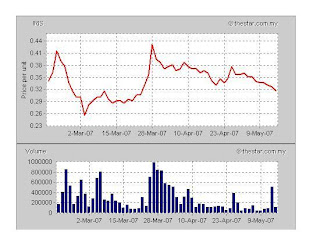
Ah-Ha... Iris (0010) from the Mesdaq, one of the darling stocks, or someone even called it one of the legends (during it's top performing weeks) of our own stock market. This is the graph from its past 3 months, if I were to post the 1 year graph, it might remind many people of their sleepless nights... Anyway, see the price movement? down from 41 cents to 26 cents (36%) within weeks and recovered from it again, within weeks.. make any sense? except for the greed and fear factors?
"Buy low, sell high" has always been the ultimate and never-changing rule in order to make a profit from any transaction. The question here is, how low is low and how high is high? How do we know it won't go lower after low and not higher after high? Well, I guess nobody knows. Although there might be a slight possibility that there are some prophets or crystal ball reading psychic somewhere in the world who are able to predict future stock movement. But if they really exist, they would have been one of the richest people in the world. I haven't seen anyone in the Forbes Richest list with occupation of "prophet or fortune telling" before.
So, what can ordinary people who doesn't possess supernatural power like us do? We need to know the underlying VALUE. When the price is selling below the value, we buy; and when the price is selling above the value, we sell. With the value in mind, you can ignore all the noices in the market, like street talk, brokers' calls, whipers from the other table when you are having lunch and etc. That's why our greatest Warren Buffett has opted to make all his investment calls from his home in a small town called Omaha rather than from Wall Street (That's why he is sometimes called The Oracle of Omaha). That's because his only concern is the fundamental and business prospect of those companies. He is not worried even if those companies are suspended from trading in the stock market for 5 years.
Back to value vs price. My believe is to buy when the price is selling below the value that I have calculated for the company and to sell when the price is higher than the value. Now, this is my system. Make sense? Please feel free to use it, not a million dollar secret, and I am not going to trademark it anyway. However, the most challenging part is yet to come. And this part is what differentiate a small time investors like us (yup, including myself, for sure) from those legendary investment gurus like Warren Buffett, Charlie Munger, Benjamin Graham, Peter Lynch and etc and etc:
How to value a company?
There are a couple of methods that most analysts use, including earnings yield, growth, profitability, effective use of capital by management, asset value relative to price, discounting model, instrinsic valuation and many many more. Honestly, I am also still looking for the answers. I would like to share some of my opinion in my future blogs. Stay tuned..
P.S. the score now? 2-1..
2 points here:
1) FA let us estimate the VALUE of a share and help us make buy and sell decision
2) The richest man on earth, Bill Gates is also a follower of Buffett's investment philosophy. So we have the World 1st and 2nd richest (and many more from the Forbes List, including a few more from Asian) to support FA here. Shouldn't we, as well?
As mentioned in my previous post, Fundamental Analysis ("FA") helps us to determine a VALUE for a particular company. Every participants of the market knows that the market is fluctuating over time. And there will be times when a particular stock will sell at very low price and sometimes, high. In fact, I think the stock market is one hell of a emotional animal. It can be extremely nice to you one day, and hurt you extremely bad the next. Let me show you an example:

Ah-Ha... Iris (0010) from the Mesdaq, one of the darling stocks, or someone even called it one of the legends (during it's top performing weeks) of our own stock market. This is the graph from its past 3 months, if I were to post the 1 year graph, it might remind many people of their sleepless nights... Anyway, see the price movement? down from 41 cents to 26 cents (36%) within weeks and recovered from it again, within weeks.. make any sense? except for the greed and fear factors?
"Buy low, sell high" has always been the ultimate and never-changing rule in order to make a profit from any transaction. The question here is, how low is low and how high is high? How do we know it won't go lower after low and not higher after high? Well, I guess nobody knows. Although there might be a slight possibility that there are some prophets or crystal ball reading psychic somewhere in the world who are able to predict future stock movement. But if they really exist, they would have been one of the richest people in the world. I haven't seen anyone in the Forbes Richest list with occupation of "prophet or fortune telling" before.
So, what can ordinary people who doesn't possess supernatural power like us do? We need to know the underlying VALUE. When the price is selling below the value, we buy; and when the price is selling above the value, we sell. With the value in mind, you can ignore all the noices in the market, like street talk, brokers' calls, whipers from the other table when you are having lunch and etc. That's why our greatest Warren Buffett has opted to make all his investment calls from his home in a small town called Omaha rather than from Wall Street (That's why he is sometimes called The Oracle of Omaha). That's because his only concern is the fundamental and business prospect of those companies. He is not worried even if those companies are suspended from trading in the stock market for 5 years.
Back to value vs price. My believe is to buy when the price is selling below the value that I have calculated for the company and to sell when the price is higher than the value. Now, this is my system. Make sense? Please feel free to use it, not a million dollar secret, and I am not going to trademark it anyway. However, the most challenging part is yet to come. And this part is what differentiate a small time investors like us (yup, including myself, for sure) from those legendary investment gurus like Warren Buffett, Charlie Munger, Benjamin Graham, Peter Lynch and etc and etc:
How to value a company?
There are a couple of methods that most analysts use, including earnings yield, growth, profitability, effective use of capital by management, asset value relative to price, discounting model, instrinsic valuation and many many more. Honestly, I am also still looking for the answers. I would like to share some of my opinion in my future blogs. Stay tuned..
P.S. the score now? 2-1..
2 points here:
1) FA let us estimate the VALUE of a share and help us make buy and sell decision
2) The richest man on earth, Bill Gates is also a follower of Buffett's investment philosophy. So we have the World 1st and 2nd richest (and many more from the Forbes List, including a few more from Asian) to support FA here. Shouldn't we, as well?
Friday, May 11, 2007
Mistakes, alot I have made - Act 1
I must confess, I have made alot of mistakes in my life as an investor. I would like to share some of them every now and then, hoping someone who read my blog might learn them the easier and cheaper way. I would also try to share my experience on how to deal with them and not to remake the mistakes.
The most important lesson that I have learnt from my past mistakes is "buying shares based on rumours without checking further into its fundamental". I have been repeating this mistake again and again without noticing it. There are instances that look so true that those who told me the news are willing to bet their head or sworn in the name of whoever they can think of. I didn't say that all news are fake, but it has to make sense, at least. Some common news are like "this company will be securing a contract or have signed an MOU with a super billionaire in China"; "someone has offered to take over the company, buy now before the price shot up.."; "this company is going to declare capital repayment of a few ringgits, the price will shoot up..", "some syndicates have signed agreement with the owner to push up the price.." and many more.
Any one of them sound familiar? Well, you are so lucky if you haven't heard any of them. yup, lucky. I've heard a couple dozens of them even though my main carear is not in the finance industry. I admit there are news that really came true, u know, once a while, but the chances of it NOT coming true are much more higher. Allow me to use another examples from gambling: How often have you heard people winning from the casinos? I do, occassionally. But the losers far outnumbered the winners. Even the winners will usually lose after a few successful runs, and usually, the losses are much more than those he had won in the past.
However, it is sometimes very hard to ignore rumours, isn't it? aren't you afraid that the rumours might turn out to be true and you are the only one left behind as the share price sky rocketed? Your uncles, aunties, brothers, sisters, neighbours, mother in law, daughter of your third grand auntie and etc are all singing praises for the syndicate while you hide at the corner kicking yourself? I kindda get use to this thinking myself.
However, if you really have to jump on the bandwagon regardless where it is heading, there are 2 questions you should ask yourself in advance.
1) What's the probability the rumours will come true?
This will require your rationale and sometimes a little logic thinking. One simple example: a company is going to have a capital repayment exercise. The easiest way is to find out whether the company have sufficient fund to do so. And, who is going to benefit from this? If the company is already in deep financial difficulties, how can they afford to do so?
Question 2, might require some homework to be done, ask yourself: What if the news doesn't come true?
It's back to fundamental analysis. There shall be a "margin of safety" or worst case scenario, if you were to hold on to the share. Let's say, a company is quoted at RM1/share and there is rumours that another company will take over them for RM1.50 per share. Your valuation told you that it shall at least worth RM1.20/share. So, in case the deal hasn't materialised, you will still be holding a share bought at a discount anyway.
Conclusion, avoid rumours and concentrate on Fundamental Analysis, if you can; else, don't forget the latter.
The most important lesson that I have learnt from my past mistakes is "buying shares based on rumours without checking further into its fundamental". I have been repeating this mistake again and again without noticing it. There are instances that look so true that those who told me the news are willing to bet their head or sworn in the name of whoever they can think of. I didn't say that all news are fake, but it has to make sense, at least. Some common news are like "this company will be securing a contract or have signed an MOU with a super billionaire in China"; "someone has offered to take over the company, buy now before the price shot up.."; "this company is going to declare capital repayment of a few ringgits, the price will shoot up..", "some syndicates have signed agreement with the owner to push up the price.." and many more.
Any one of them sound familiar? Well, you are so lucky if you haven't heard any of them. yup, lucky. I've heard a couple dozens of them even though my main carear is not in the finance industry. I admit there are news that really came true, u know, once a while, but the chances of it NOT coming true are much more higher. Allow me to use another examples from gambling: How often have you heard people winning from the casinos? I do, occassionally. But the losers far outnumbered the winners. Even the winners will usually lose after a few successful runs, and usually, the losses are much more than those he had won in the past.
However, it is sometimes very hard to ignore rumours, isn't it? aren't you afraid that the rumours might turn out to be true and you are the only one left behind as the share price sky rocketed? Your uncles, aunties, brothers, sisters, neighbours, mother in law, daughter of your third grand auntie and etc are all singing praises for the syndicate while you hide at the corner kicking yourself? I kindda get use to this thinking myself.
However, if you really have to jump on the bandwagon regardless where it is heading, there are 2 questions you should ask yourself in advance.
1) What's the probability the rumours will come true?
This will require your rationale and sometimes a little logic thinking. One simple example: a company is going to have a capital repayment exercise. The easiest way is to find out whether the company have sufficient fund to do so. And, who is going to benefit from this? If the company is already in deep financial difficulties, how can they afford to do so?
Question 2, might require some homework to be done, ask yourself: What if the news doesn't come true?
It's back to fundamental analysis. There shall be a "margin of safety" or worst case scenario, if you were to hold on to the share. Let's say, a company is quoted at RM1/share and there is rumours that another company will take over them for RM1.50 per share. Your valuation told you that it shall at least worth RM1.20/share. So, in case the deal hasn't materialised, you will still be holding a share bought at a discount anyway.
Conclusion, avoid rumours and concentrate on Fundamental Analysis, if you can; else, don't forget the latter.
Thursday, May 10, 2007
Fundamental Analysis, I trust - part 2
I am a strong believer that buying shares of a company is akin to buying a PORTION of OWNERSHIP of that listed company and its underlying businesses and assets. And being a value investor, there shall only be 1 reason to do so, which is when the share PRICE of a company is selling BELOW its underlying VALUE. Different people will have different ways of valuing a company and as far as I know, there is no one sure-fire strategy to guarantee profit and obtain above average returns. And, that's the reason why I always agree on the saying that "investing is an ART", not science.
Let me start off my series on "Fundamental Analysis" ("FA") with its own shortcomings first (I usually prefer to taste the bitter parts before the sweet ones). One major argument against FA is that the analysis is based on numbers, prepared by accountants, whom are believed to be one of the most talented and sometimes, creative bunch of people in the world. Don't agree? allow me to share a story, which my accounting lecturer used to share with me:
There once was a business owner who was interviewing people for a division manager position. He decided to select the individual that could answer the question "how much is 2+2?"
The engineer pulled out his slide rule and shuffled it back and forth, and finally announced, "It lies between 3.98 and 4.02".
The mathematician said, "In two hours I can demonstrate it equals 4 with the following short proof."
The attorney stated, "In the case of Svenson vs. the State, 2+2 was declared to be 4."
The accountant looked at the business owner, then got out of his chair, went to see if anyone was listening at the door and pulled the drapes. Then he returned to the business owner, leaned across the desk and said in a low voice, "What would you like it to be?"
In other words, "numbers can lie"... This point of argument against FA certainly stands strong, or else, aren't the collapse of Enron, WorldCom and some other major corporate scandals living proofs? These companies have dozens if not hundreds of professionals monitoring their accounting reports closely, if FA works, many ignorant investors would not have been burnt so badly.. and not to mention the recent case of Transmile on our own Malaysian soil, which had caused its own shares to plummet more than 30% within a week. Reason? according to filings, auditors could not finalize accounts within stipulated period in absence of "relevant supporting documentation from management on certain transactions relating to trade receivables and related sales and additions to property, plant and equipment." and people starts to question the genuine of their past reports and etc.
Well, to defense against these, I would say...er... "u got me there, haha!!"
Seriously, cases like these do happen every now and then. We have to put in some extra efforts like closer monitoring; be extra careful while crunching the numbers; observe a few more years of its past records to look for consistence, and be very sceptical when there are extraordinarily good or bad years; and etc. The rest, we can only put our faith on the integrity of its management and auditors.
(By the way, if you want to see some good examples on number crunching, a good place will be at one of my favorite blogs, created by Moolah @ http://whereiszemoola.blogspot.com/. Do check it out!! He's good!!)
Ok. the score? 0 - 1 ..
to be continued..
Let me start off my series on "Fundamental Analysis" ("FA") with its own shortcomings first (I usually prefer to taste the bitter parts before the sweet ones). One major argument against FA is that the analysis is based on numbers, prepared by accountants, whom are believed to be one of the most talented and sometimes, creative bunch of people in the world. Don't agree? allow me to share a story, which my accounting lecturer used to share with me:
There once was a business owner who was interviewing people for a division manager position. He decided to select the individual that could answer the question "how much is 2+2?"
The engineer pulled out his slide rule and shuffled it back and forth, and finally announced, "It lies between 3.98 and 4.02".
The mathematician said, "In two hours I can demonstrate it equals 4 with the following short proof."
The attorney stated, "In the case of Svenson vs. the State, 2+2 was declared to be 4."
The accountant looked at the business owner, then got out of his chair, went to see if anyone was listening at the door and pulled the drapes. Then he returned to the business owner, leaned across the desk and said in a low voice, "What would you like it to be?"
In other words, "numbers can lie"... This point of argument against FA certainly stands strong, or else, aren't the collapse of Enron, WorldCom and some other major corporate scandals living proofs? These companies have dozens if not hundreds of professionals monitoring their accounting reports closely, if FA works, many ignorant investors would not have been burnt so badly.. and not to mention the recent case of Transmile on our own Malaysian soil, which had caused its own shares to plummet more than 30% within a week. Reason? according to filings, auditors could not finalize accounts within stipulated period in absence of "relevant supporting documentation from management on certain transactions relating to trade receivables and related sales and additions to property, plant and equipment." and people starts to question the genuine of their past reports and etc.
Well, to defense against these, I would say...er... "u got me there, haha!!"
Seriously, cases like these do happen every now and then. We have to put in some extra efforts like closer monitoring; be extra careful while crunching the numbers; observe a few more years of its past records to look for consistence, and be very sceptical when there are extraordinarily good or bad years; and etc. The rest, we can only put our faith on the integrity of its management and auditors.
(By the way, if you want to see some good examples on number crunching, a good place will be at one of my favorite blogs, created by Moolah @ http://whereiszemoola.blogspot.com/. Do check it out!! He's good!!)
Ok. the score? 0 - 1 ..
to be continued..
Wednesday, May 09, 2007
KLCI breaking into new heights
The KLCI has retraced from its all time high achieved 3 days ago, so does a couple other market index around the globe, including the HSI, STI, Nikkei and etc.. except for the Shanghai and Dow, of course. This neighbour of ours called the Middle Kingdom is really doing one hell of a GREAT JOB in building itself into a world economic powerhouse. Today, when it sneezes, i think half the world will catch a cold (i am not referring to the SARS years ago). I am referring to a more servere economic meltdown if its bubble bursts. One can only use imagination to predict how far it can goes. Can anyone imagine the Shangahai Index reaching this level 2 years ago (the SSE index has just breached through 4000 points as of this writing, from a low of 1000+ points in mid 2005)? Just look at the graph below. It's an index, mind you, not an individual stocks.
Well, to be realistic, that's gonna be least of our concern, as long as our own market is performing accordingly. After much strugglings and hiccups along the way, our own KLCI has FINALLY broke through its historical high and is now in a whole new territory. I don't think this is much to celebrate about as many others have already done this months ago. We are merely playing catch up. Anyway, late is better than never, right?
So, what's next? where do we go from here? Is this sustainable? Or is this the peak we are going to tell our kids years later that, "hey, u know, your dad used to be watching the KLCI reached its all time high at 1365 (or something like that, i don't remember)" in year 2007? These are all answers we are going to know only few years later. Who knows, it might instead reached 1500 or 2000 points as predicted by some of those hard-core analysts after all. It's a choice between being conservative and lock in the profits made so far or take the risk of venturing forward with the rest, most if not all, i would say. (kicking yourself at the corner while others are celebrating usually left a bad taste in the mouth, isn't it?). I believe that some of those that have liquidated during the 1200 points have jumped back into the market. agree?
I don't have a crystal ball that is working properly, I have to based my decision on some sort of plan. As a value investor, whenever I cannot decide on "when to buy", I will look for "what to buy". There are certainly a few stocks out there that are still selling at attractive price, relative to its underlying value. As for my technical analysts friends, I don't know what you think, but I guess you do have a whole tables of graphs that help you make your decisions. This is the beauty of having a system to follow.. see? or else, you will be indifference from those that are betting blindly on the black jack tables and keep shouting "pictures! pictures!" every now and then (ask a gambler friends if you haven't been to a casino before. I beleive this wonderful scene is more seen in Asians casinos)..

Well, to be realistic, that's gonna be least of our concern, as long as our own market is performing accordingly. After much strugglings and hiccups along the way, our own KLCI has FINALLY broke through its historical high and is now in a whole new territory. I don't think this is much to celebrate about as many others have already done this months ago. We are merely playing catch up. Anyway, late is better than never, right?
So, what's next? where do we go from here? Is this sustainable? Or is this the peak we are going to tell our kids years later that, "hey, u know, your dad used to be watching the KLCI reached its all time high at 1365 (or something like that, i don't remember)" in year 2007? These are all answers we are going to know only few years later. Who knows, it might instead reached 1500 or 2000 points as predicted by some of those hard-core analysts after all. It's a choice between being conservative and lock in the profits made so far or take the risk of venturing forward with the rest, most if not all, i would say. (kicking yourself at the corner while others are celebrating usually left a bad taste in the mouth, isn't it?). I believe that some of those that have liquidated during the 1200 points have jumped back into the market. agree?
I don't have a crystal ball that is working properly, I have to based my decision on some sort of plan. As a value investor, whenever I cannot decide on "when to buy", I will look for "what to buy". There are certainly a few stocks out there that are still selling at attractive price, relative to its underlying value. As for my technical analysts friends, I don't know what you think, but I guess you do have a whole tables of graphs that help you make your decisions. This is the beauty of having a system to follow.. see? or else, you will be indifference from those that are betting blindly on the black jack tables and keep shouting "pictures! pictures!" every now and then (ask a gambler friends if you haven't been to a casino before. I beleive this wonderful scene is more seen in Asians casinos)..
Friday, May 04, 2007
Fundamental Analysis, I trust - part 1
Fundamental vs Technical Analysis
Recently, I have a friend who wanted to start investing in the share market and asked for my advice. To be honest, I think this is definitely not the best time to enter the market (to be discussed later), nevertheless, I told him that he must first start with establishing some kind of system. This system will help him in selecting counter to buy and time to make the buy/sell decision. I further pointed out to him that there are many types of "players" in the market, but they can mainly be separated into 2 main streams: fundamental analyst and technical analysts.
Fundamental analysts are those "players" who believe that the "true value" of the company will be reflected in its share price, sooner or later. The most notable fundamental analysts includes the legendary Benjamin Graham, known as "Father of Value Investing"; Warren Buffett, "The Oracle of Omaha", and his partner, Charlie Munger who are both currently at the helm of their multi Billion investment vehicle, Berkshire Hathaway; Peter Lynch, the legendary fund manager; and many more. These are all very successful investors and are all very respectable figures in the financial world. They believe in buying a dollar with a penny and buying shares in a company will make them part owners of the company. I am a firm follower from this school of thought.
As for tehnical analysts, they put emphasize in studying the trendlines and signals in price graphs. They derived methods to predict the future movements of share price from their past. I am not good at this and hence, is not in a position to comment further.
And of course, there are also players who believe that they can extract the good points from both of these investment strategies and I will call them the hybrid investors. I have known a few people who have been very successful in doing this in real life. They use the fundamental analysis to locate good companies and they use they use technical analysis to look for entry signals to start accumulating their shares.
In conclusion, I told the friend that one must put in hard work in order to be successful in the share market, there are no easy way out. Well, of course, I do tell him, "if you believe in luck and that the share market is nothing different from a casino, then I can only bid you good luck". It goes the same to the rest of the gamblers..
Recently, I have a friend who wanted to start investing in the share market and asked for my advice. To be honest, I think this is definitely not the best time to enter the market (to be discussed later), nevertheless, I told him that he must first start with establishing some kind of system. This system will help him in selecting counter to buy and time to make the buy/sell decision. I further pointed out to him that there are many types of "players" in the market, but they can mainly be separated into 2 main streams: fundamental analyst and technical analysts.
Fundamental analysts are those "players" who believe that the "true value" of the company will be reflected in its share price, sooner or later. The most notable fundamental analysts includes the legendary Benjamin Graham, known as "Father of Value Investing"; Warren Buffett, "The Oracle of Omaha", and his partner, Charlie Munger who are both currently at the helm of their multi Billion investment vehicle, Berkshire Hathaway; Peter Lynch, the legendary fund manager; and many more. These are all very successful investors and are all very respectable figures in the financial world. They believe in buying a dollar with a penny and buying shares in a company will make them part owners of the company. I am a firm follower from this school of thought.
As for tehnical analysts, they put emphasize in studying the trendlines and signals in price graphs. They derived methods to predict the future movements of share price from their past. I am not good at this and hence, is not in a position to comment further.
And of course, there are also players who believe that they can extract the good points from both of these investment strategies and I will call them the hybrid investors. I have known a few people who have been very successful in doing this in real life. They use the fundamental analysis to locate good companies and they use they use technical analysis to look for entry signals to start accumulating their shares.
In conclusion, I told the friend that one must put in hard work in order to be successful in the share market, there are no easy way out. Well, of course, I do tell him, "if you believe in luck and that the share market is nothing different from a casino, then I can only bid you good luck". It goes the same to the rest of the gamblers..
Subscribe to:
Posts (Atom)

